
Saline County Criminal Court Records
A Saline County criminal court record is the court case file created after a prosecutor files a criminal accusation. In District Court, the Clerk of the District Court maintains the file and routes criminal case questions through the criminal desk. The file may include the complaint or information, bond orders, counsel appointments, arraignment entries, pleas, motions, hearing notices, trial settings, disposition, sentence, probation conditions, restitution, fines, costs, and revocation entries.
The District Court handles felony and misdemeanor cases filed under Kansas law. Salina Municipal Court handles city misdemeanor, DUI, traffic, parking, animal-control, petty theft, disorderly conduct, domestic-violence, and other city ordinance cases. A person comparing filed counts with arrest details should use Saline County arrest records and court charges for the arrest-to-charge path, then return to the criminal case file for the final outcome.
The Saline County Attorney page is one official source for the local prosecutor's office and diversion services.

The County Attorney source matters because prosecutor filings are what turn a law-enforcement report into formal charges in a District Court case.
Search Saline County Criminal Court Records
District Court criminal records are searched through the Kansas court public access path linked by the Clerk of the District Court. The Kansas District Court Public Access Portal requires users to accept the public access agreement before entering. Kansas Judicial Branch guidance also says district court case information and case records can be searched on courthouse terminals when online access does not show the needed file.
- Open Kansas CaseSearch from the clerk page or the state portal and accept the user agreement.
- Search by case number when known, or by defendant name if that search is available.
- Confirm the court is Saline County District Court or Salina Municipal Court before relying on the result.
- Read the docket in date order to track charges, hearings, pleas, disposition, and sentencing entries.
- Request certified or nonpublic-access copies from the Clerk of the District Court when the document is not online.
Kansas KBI criminal history is a fee-based statewide background search, not the same as a Saline County criminal court case file. KDOC KASPER shows a state correctional population record and warns that it is not a complete criminal history.
Saline County Criminal Case Stages
A criminal record is easiest to read as a sequence. The charge starts the court case, the arraignment records the formal presentation of the charge and plea, pretrial entries show motions and hearings, and the final entries show whether the case ended by plea, trial, dismissal, diversion, or another disposition. Sentencing entries may add jail, probation, restitution, fines, court costs, and later revocation or compliance events.
Case flow: Charges Filed › Arraignment › Pretrial / Motions › Plea or Trial › Disposition › Sentencing
| Stage | What Happens |
|---|---|
| Charges Filed | The prosecutor files a complaint or information, and the court file begins tracking counts and statutes. |
| Arraignment | The defendant is advised of the charge and enters a plea, often not guilty at the first stage. |
| Pretrial / Motions | The docket may show discovery, motions, continuances, bond changes, and hearing settings. |
| Plea or Trial | The case resolves by plea, bench or jury trial, dismissal, diversion, or another court action. |
| Sentencing | The record may show jail, prison, probation, costs, restitution, fines, and supervision conditions. |
What Saline County Criminal Records Show
Public criminal case fields vary by portal, case type, and confidentiality rule. A docket may be visible while documents are hidden or terminal-only. Juvenile, sealed, expunged, and certain protection or personal-identifier details are not ordinary public fields. For a complete record, compare the docket, available public documents, and clerk copy options.
| Field | What It Shows |
|---|---|
| Case Number | The assigned court number used to search and request the criminal case file. |
| Defendant | The person charged, plus attorneys or appointed counsel when public. |
| Charges | Count number, statute or city code, offense description, severity, and amendments if public. |
| Bond | Bond amount, release type, no-bond hold, or release conditions when entered publicly. |
| Plea | Guilty, not guilty, no contest, or other plea entry shown in the docket or journal entry. |
| Disposition | The outcome of a count or case, including dismissal, conviction, acquittal, diversion, or plea result. |
| Sentence | Jail, prison, probation, restitution, fines, costs, and supervision terms when public. |
Saline County Charges vs Convictions
A filed charge is an accusation. A conviction is a final guilty finding or accepted plea. Saline County criminal court records can show charges that were amended, reduced, dismissed, diverted, or resolved by acquittal. This is why the disposition line matters as much as the original charge list.
| Charge | Conviction | |
|---|---|---|
| Stage | Accusation | Verdict or plea |
| Burden of Proof | Probable cause | Beyond reasonable doubt |
| Public Record | Often visible unless restricted | Often visible unless sealed or expunged |
| Meaning | The case has been filed or alleged | The charge ended in guilt by plea or verdict |
Read Saline County Criminal Sentences
Disposition is the outcome of a charge or case. Common plain-language outcomes include guilty, not guilty, dismissed, diverted, amended, reduced, or no contest. A sentence is the punishment or court-ordered terms after conviction. It may include jail, prison, probation, restitution, fines, court costs, treatment conditions, no-contact terms, or later revocation entries.
The KDOC KASPER page is relevant because post-sentence custody can move beyond the county case file.
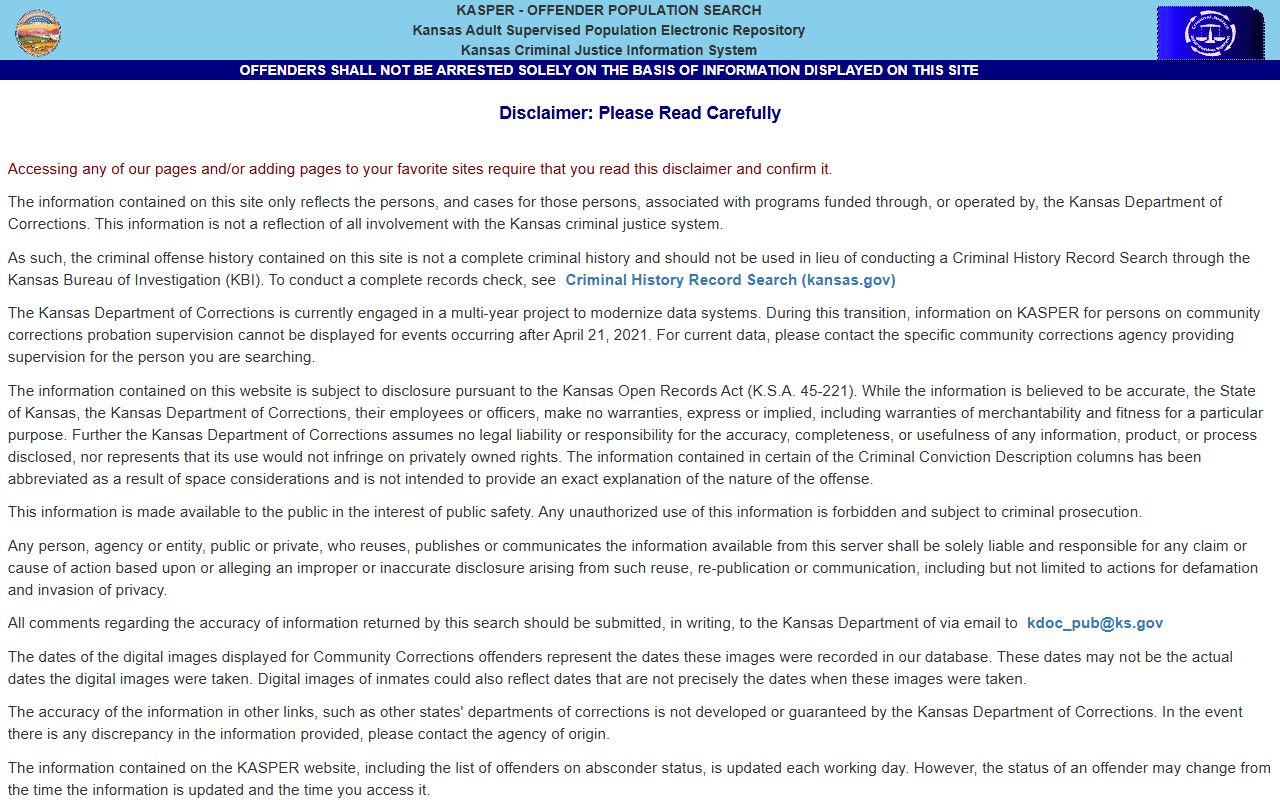
KASPER can help with state custody or supervision context, but KDOC states that it is not a complete criminal history record.
Sealed Saline County Criminal Records
Sealed and expunged records are different. A sealed record is hidden from general public access by law or court order. An expunged Kansas criminal, arrest, or diversion record has restricted public access after a petition is granted under the applicable statute. Neither term means every agency copy has been erased for every legal purpose.
| Sealed | Expunged | |
|---|---|---|
| Visibility | Hidden from general public access | Limited from public view after court approval |
| Law Enforcement | May retain access depending on order and law | May retain access for later criminal-justice or licensing uses |
| Eligibility | Based on statute, case type, or court order | Based on Kansas waiting periods, offense type, and petition requirements |
The image from K.S.A. 21-6614 ties Saline County criminal records to the Kansas conviction, arrest-record, and diversion expungement process.
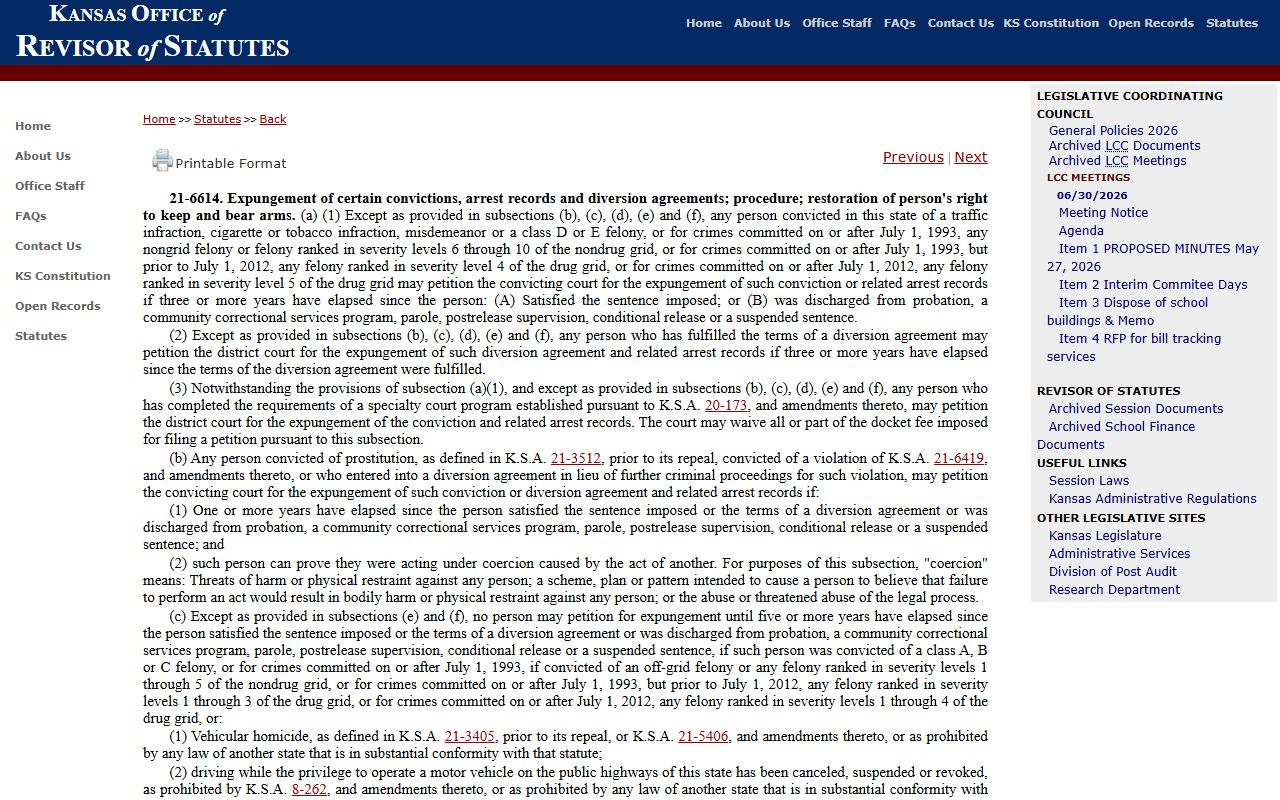
That statute is a starting point for eligibility, but the actual petition belongs in the court that handled the criminal case.
Public Access to Saline County Criminal Records
Kansas public access is shaped by the Kansas Open Records Act and court-specific access rules such as Kansas Supreme Court Rule 106B. District court records can be searched online or at courthouse terminals, but electronic access may omit confidential data, sealed documents, juvenile matters, and redacted identifiers.
Key Statutes:
K.S.A. 45-216 - Kansas public policy opens public records unless another law closes them.
K.S.A. 22-2410 - Kansas provides an expungement path for certain arrest records when proceedings do not result in conviction.
The K.S.A. 22-2410 source image is included because non-conviction arrest records are a common criminal-record access issue.
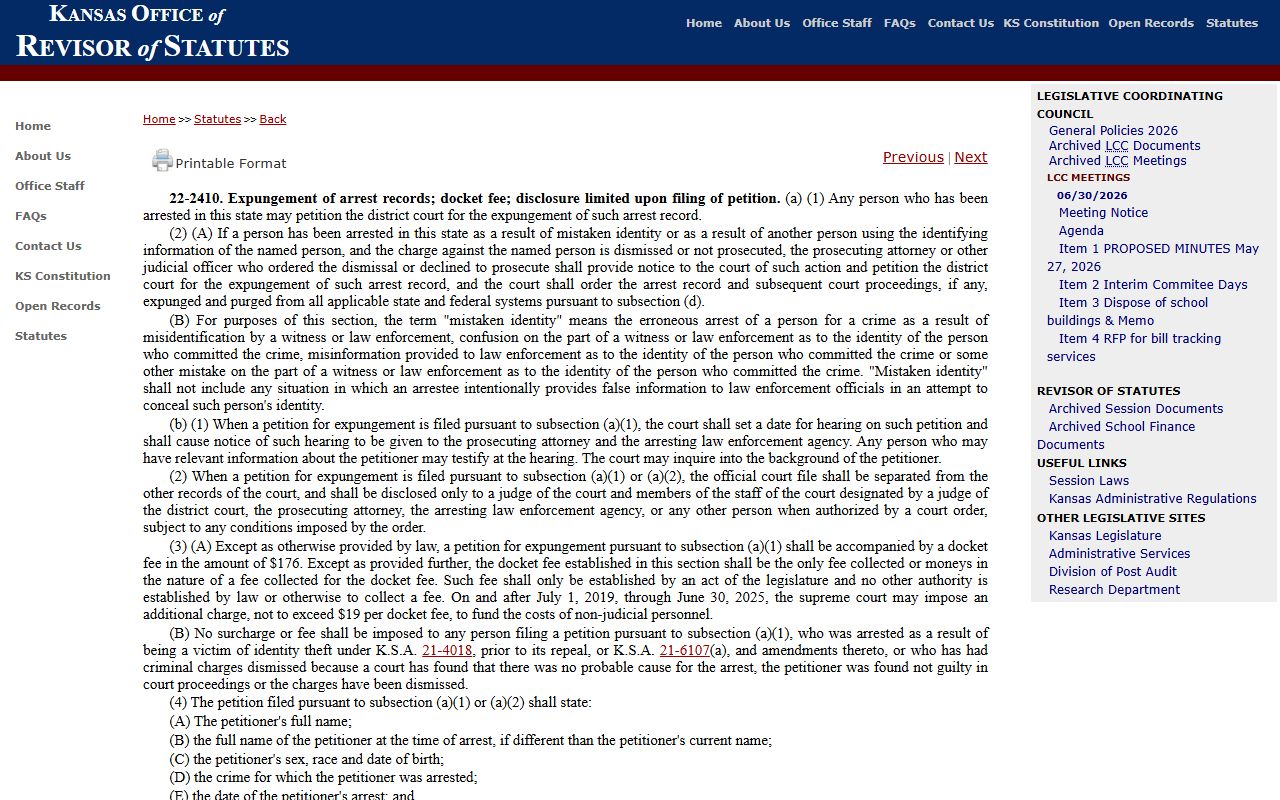
It helps distinguish a court case outcome from the separate statutory process for limiting public access to certain arrest records.
Saline County Criminal Background Checks
KBI criminal history checks are statewide background records and may be fee-based. They do not replace the District Court file, the municipal case docket, or an official copy requested from the clerk. Employers, landlords, insurers, lenders, and other regulated users must follow the Fair Credit Reporting Act and any Kansas rules that apply to their use of criminal history information.
Important: Do not use casual criminal court searches as a substitute for legally compliant background screening.
Restricted Saline County Criminal Records
Restricted Saline County criminal court records include juvenile matters, sealed files, expunged records, certain arrest records, protected identifiers, and sensitive protection-order information. Adoption and mental-health records are not ordinary criminal public records. If a portal result is missing, the absence may reflect a sealed case, a nonpublic case type, a not-yet-digitized file, or a court rule that limits online display.